Our third Family History Discussion Group session moved into new territory: using DNA to support genealogy research. We started with a quick check-in on the FamilySearch/Ancestry linking work from Session 2, then spent the rest of the evening on how DNA testing actually works and how it can break through research dead ends.
The Basics: How DNA Passes Down
DNA is the hereditary material each of us receives from our parents, 100% from each, found in every cell in the body. As it passes down through generations, the amount you share with a relative roughly halves each step:
- Parent/child: ~50%
- Grandchild: ~25% (first cousin range)
- Great-grandchild: ~12.5% (second cousin range)
- 2x great-grandchild: ~6.25% (third cousin range)
One key clarification: DNA isn’t measured in clean percentages — it’s measured in centimorgans (cM). Because DNA doesn’t split evenly among siblings, two siblings can each inherit a different amount from the same parent, which is why match charts give a range rather than a fixed number for each relationship.
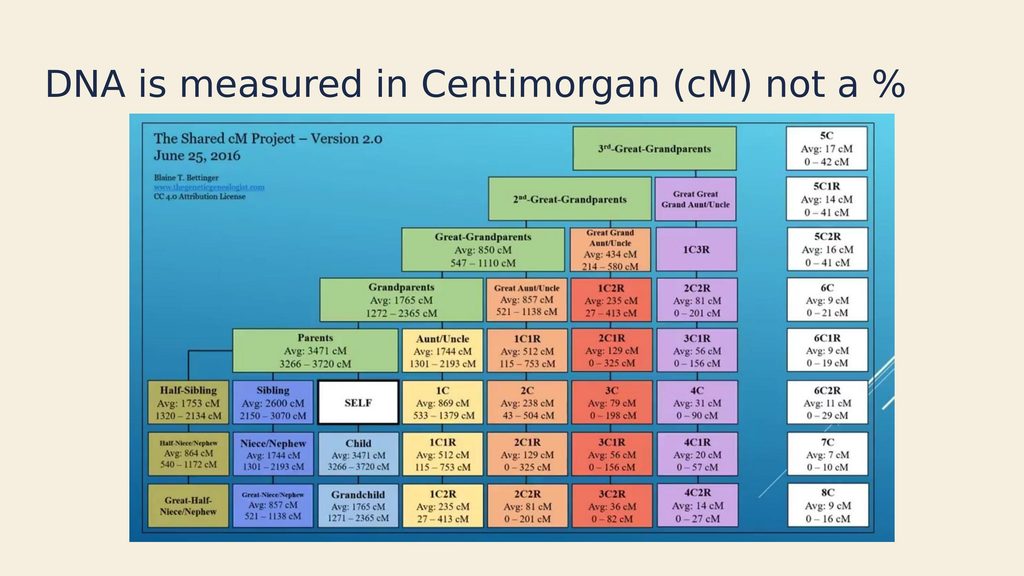
We also covered the “removed” terminology that trips a lot of people up: “once removed” simply means the two people are one generation apart. Your first cousin’s child is your first cousin once removed; your first cousin’s grandchild is twice removed.
What DNA Testing Is Actually Good For
Beyond building out a family tree, DNA testing can help:
- Solve paternity or adoption questions
- Identify unknown parentage
- Break down brick walls in family lines
- Flag inherited health conditions worth watching for in your research
- Confirm or challenge assumed ethnicity
FamilySearch vs. the Paid Testing Services
FamilySearch is enormous, nearly 17 billion searchable names, over 1.8 billion people in the shared Family Tree. It has one major gap: no DNA testing of its own. For that, you need a third-party partner. Several services sync with FamilySearch and let you build a tree or import a GEDCOM file, but only two currently offer DNA testing:
| Services | Main Focus | DNA Testing |
|---|---|---|
| Ancestry (ancestry.com) | United States records | Yes – (sale pricing a few times a year) |
| MyHeritage (myheritage.com) | Global records | Yes – (check for sale pricing) |
| Storied | Newspapers, records, memory-keeping | No |
| Geneanet | French records | No (DNA data upload/matching only) |
| Findmypast | British & Irish records | No |
| American Ancestors | Early American Records | No |
| Filae | French records | No |
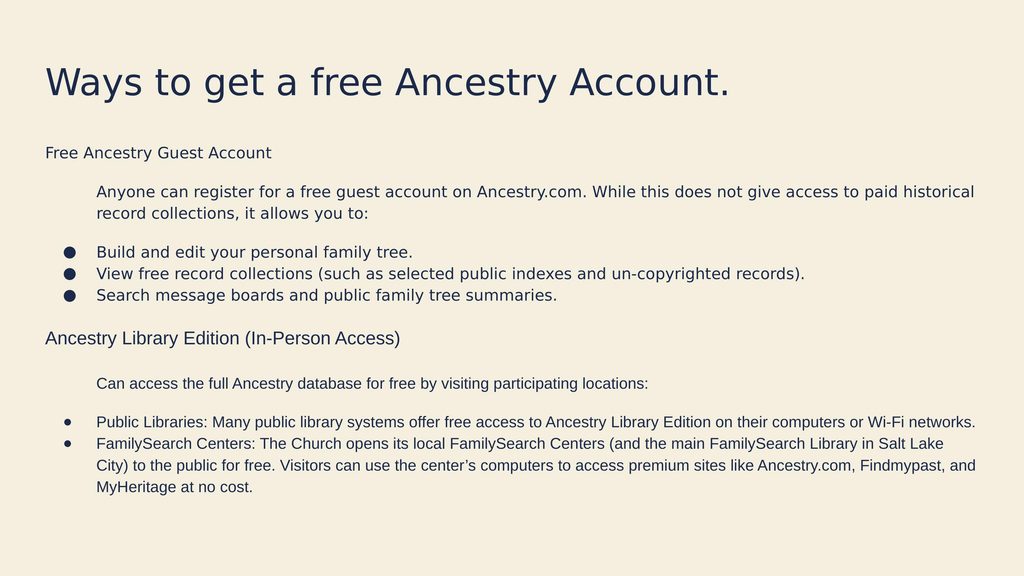
For members of the Church, an Ancestry account through the free FamilySearch partnership includes full record access — you just won’t get Ancestry’s paid “ProTools” features or a free DNA kit.
Reading an Ancestry Family Tree
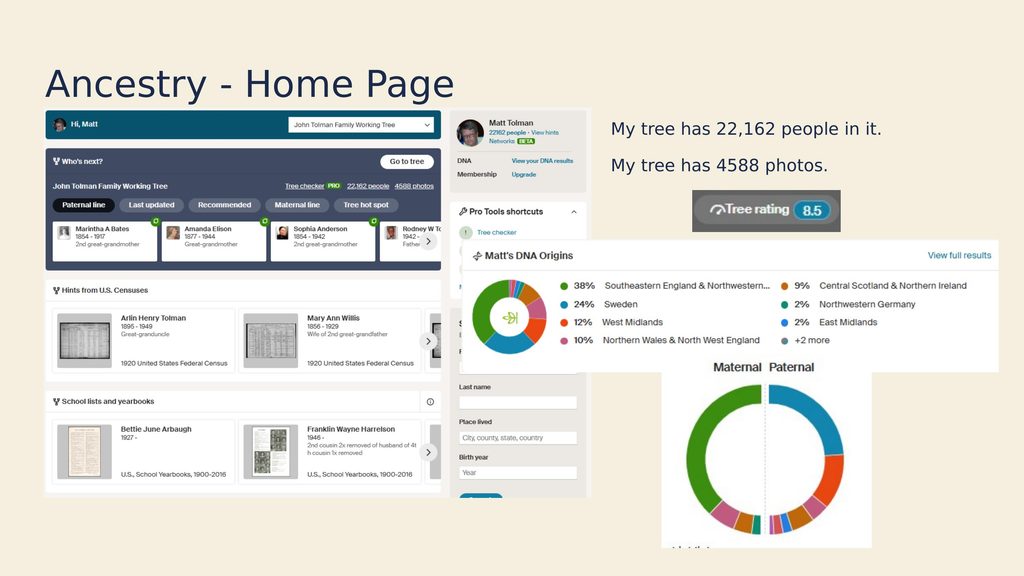
Once your tree and DNA results are connected, Ancestry starts surfacing hints and matches directly in the tree view. Every profile page gives you a timeline of events, a source list, and family relationships:
In the tree view itself, three symbols do most of the work:
- Green leaf: Ancestry believes it found a record for that person; review before accepting.
- Dark blue symbol: You have DNA matches in common through that ancestor.
- Light blue DNA symbol: You’ve connected a DNA match to that individual’s profile.
From the DNA Matches page, you can sort by parent, ancestor, cluster, or location, and see both the shared cM and the predicted relationship for each match.
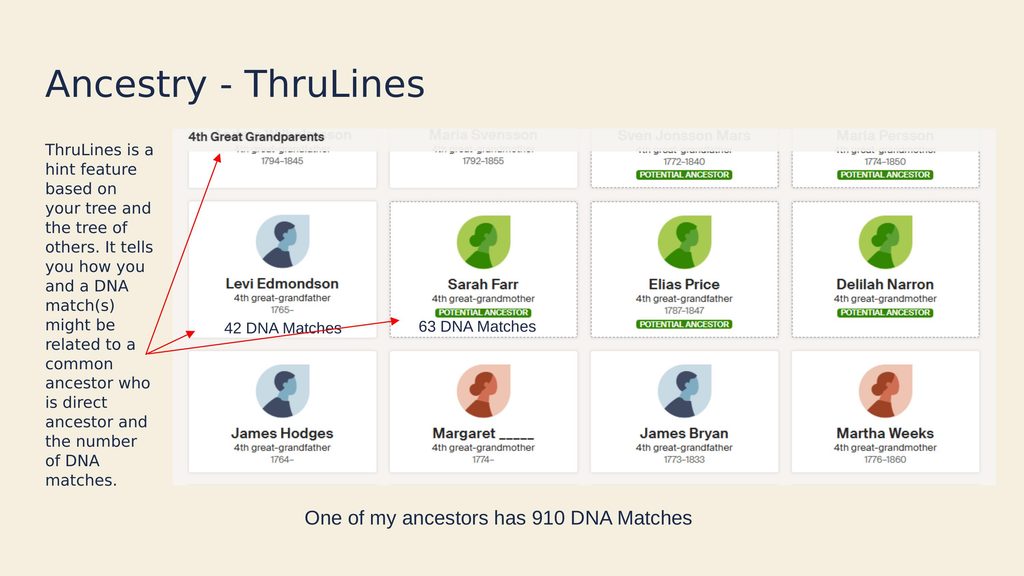
ThruLines takes this further — it’s a hinting feature that maps out how you and a DNA match might connect through a common ancestor, including how many generations and matches separate you:
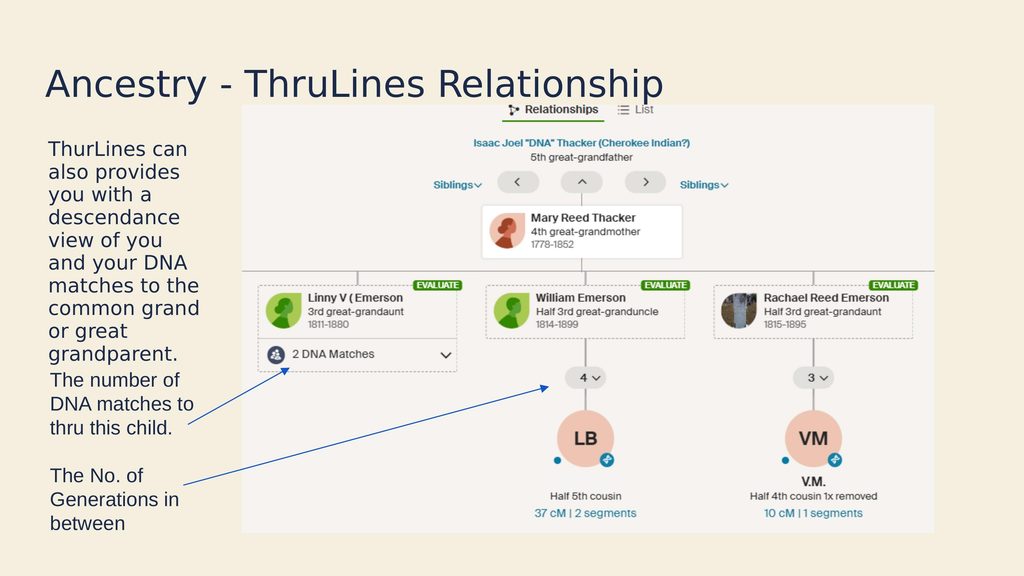
It can also show a descendance view — mapping out exactly how a DNA match connects back to a shared ancestor, generation by generation:
Case Study: Breaking a Real Brick Wall
One of the most useful parts of the evening was walking through two real research problems solved with DNA.
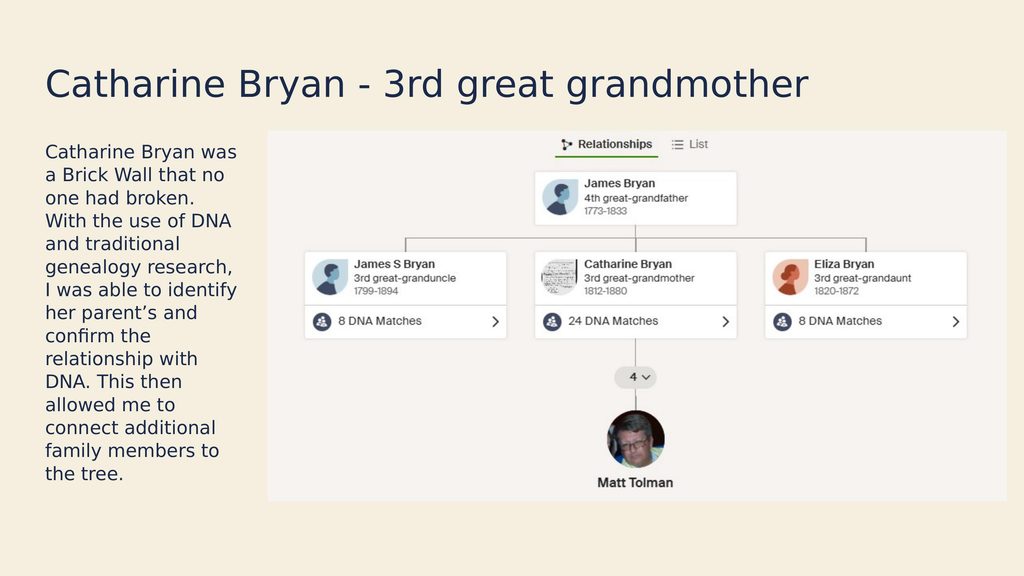
A third-great-grandmother with no known parents. Catharine Bryan had been a dead end for as long as I’d been doing genealogy. After years with no progress, a probate record for an unrelated estate happened to name her as a sibling of the deceased — which identified her siblings. Cross-referencing those siblings’ DNA matches led back to her father, James Bryan, confirming the connection traditional records alone couldn’t provide.
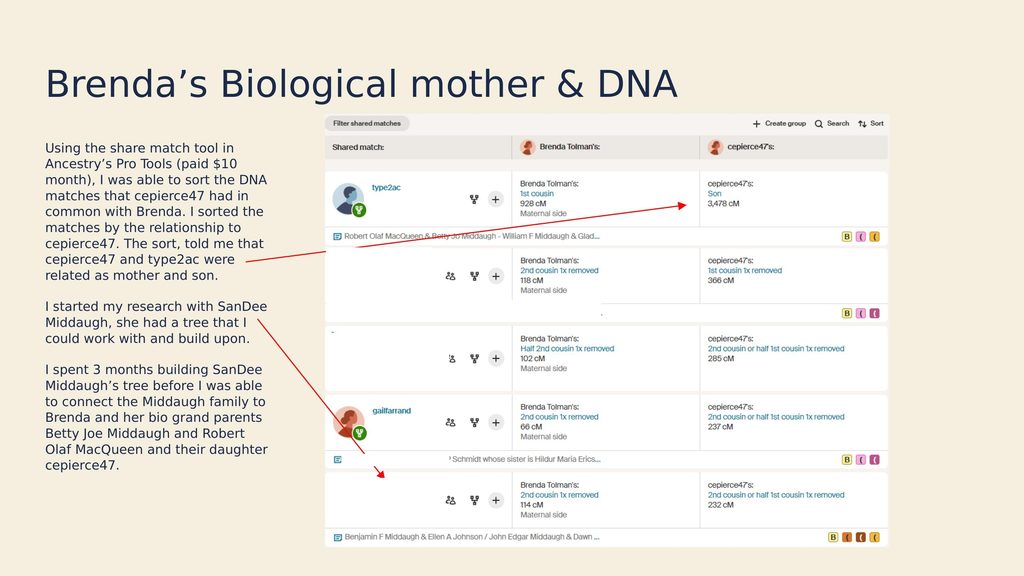
An unknown biological parent. This one’s closer to home — it’s how we identified my wife Brenda’s biological family. Starting from a DNA match with no attached tree and only a partial username — “cepierce47” — to go on, I sorted matches by shared cM and slowly built out a stranger’s family tree from scratch, over several months, until the connections lined up.
None of it would have been possible without DNA laid on top of traditional research. The common thread in both cases: DNA doesn’t replace genealogy research — it gives you a second, independent way to confirm (or challenge) the paper trail, and it can open doors that records alone can’t.
Where to Go From Here
If you’re ready to start:
- Test the oldest living generation you have access to; the further back the tester, the further back the useful match data goes.
- Set up your FamilySearch-linked Ancestry account while your kit is in transit.
- Register your test kit to your account as soon as it arrives (save the box — it has the codes you’ll need).
- Start building your tree in the meantime, so hints are waiting when results land.
- Once results come in, don’t rush. Just look around and see who you recognize.
A Few Places to Start
- Genealogy TV — Connie Knox’s channel, new videos most Fridays, general research skills and strategy.
- Your DNA Guide — Diahan Southard’s channel, focused specifically on turning DNA results into real family connections.
- Genealogy with Dana Leeds — creator of the Leeds Method for sorting DNA matches into color clusters.
- DNA Painter — free tools for chromosome mapping and figuring out how a match might fit into your tree.
- BYU Family History Library — runs live seminars most Sundays; check their site for the current schedule.
- RootsTech — the big annual genealogy conference; past session recordings are usually free to watch online.